

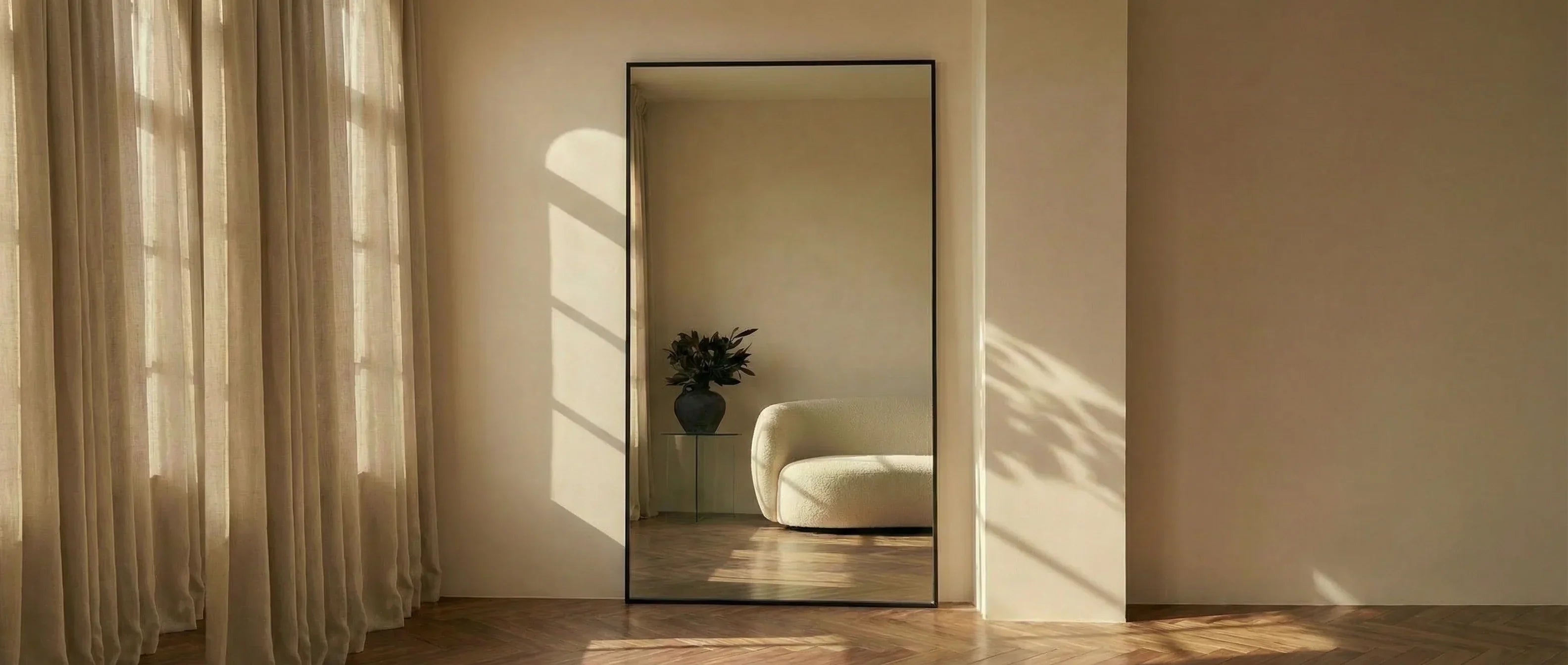
Mirrors in Home Decor
The Quiet Power of Mirrors in Home Decor
There's a moment that happens in almost every well-designed room. The eye travels across furniture, past the sofa, over the rug, and then—something catches the light. A mirror. And suddenly the whole space feels different. Larger. Brighter. More intentional.
Mirrors are one of the most underestimated elements in home decor. They're often treated as purely functional—something for checking an outfit before heading out the door. But in the hands of someone who understands their potential, mirrors become transformative. They manipulate light, create depth, and bring a sense of elegance that few other pieces can match.
Whether it's a full height mirror leaning casually against a bedroom wall, an arched mirror adding architectural interest above a console, or an oversized statement piece anchoring a living room—the right mirror doesn't just reflect a space. It completes it.
Why mirrors matter more than most realise
Light is everything in interior design. It determines how colours appear, how textures read, and how a room feels at different times of day. Mirrors are, essentially, tools for directing light. A mirror placed opposite a window pulls natural light deeper into a space. One positioned near a lamp amplifies its warm glow in the evening. The effect is subtle but significant—rooms with well-placed mirrors simply feel more alive.
Then there's the illusion of space. In compact rooms—which so many modern homes have—mirrors create the perception of depth. A large mirror on one wall can make a narrow living room feel twice as wide. A full length mirror in a small bedroom opens up the entire space visually. It's one of the oldest tricks in design, and it works every single time.
But beyond the practical magic, mirrors bring something else: presence. A beautiful mirror commands attention the way a piece of art does. The frame, the shape, the scale—these choices say something about the space and the person who created it. A room without mirrors often feels unfinished, even if everything else is perfectly in place.
Full height mirrors: the effortless statement
There's something undeniably elegant about a full height mirror. Standing tall from floor to nearly ceiling, these mirrors make an impact that smaller pieces simply can't achieve. They're dramatic without trying too hard—a single object that transforms an entire wall.
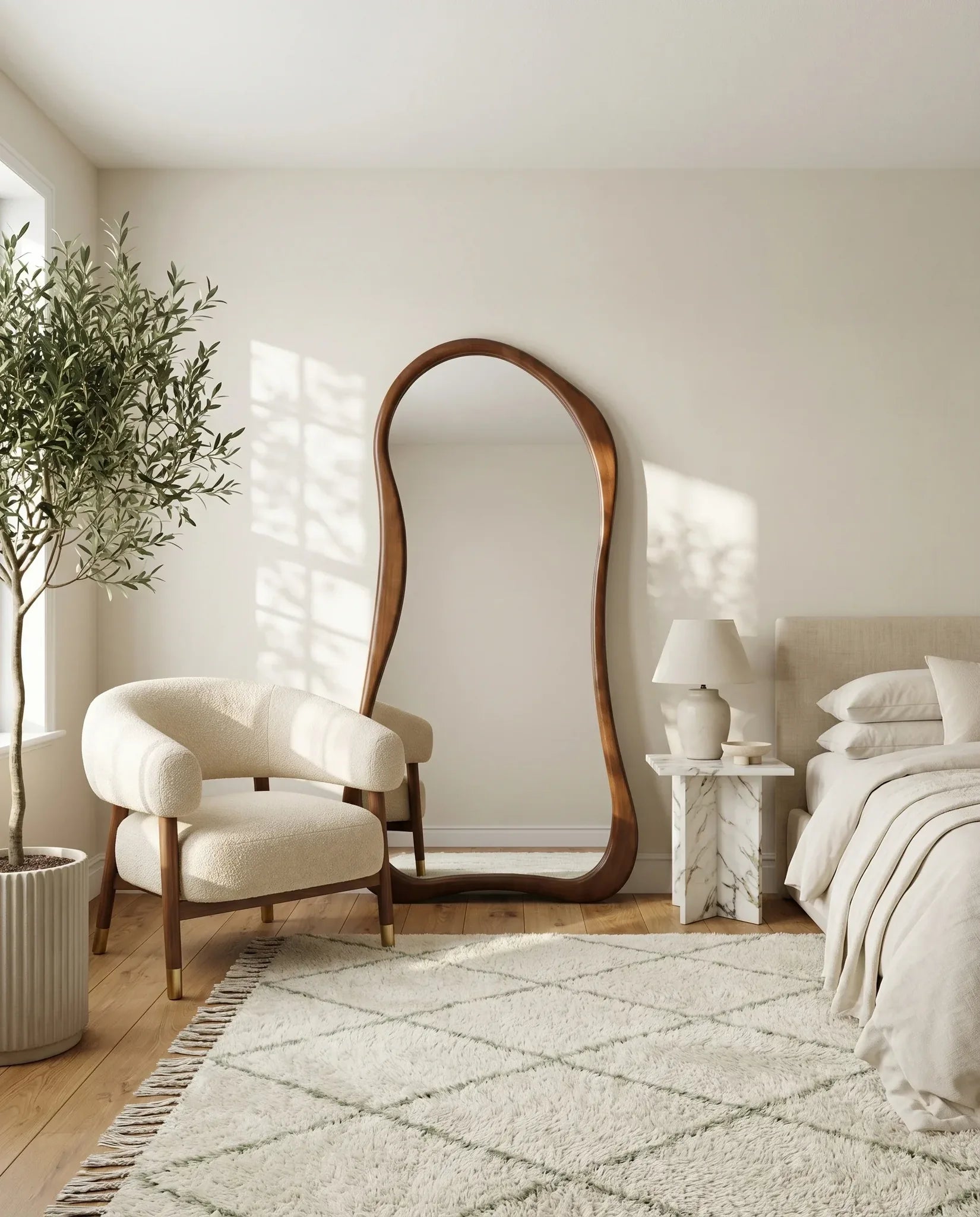
Full height mirrors work beautifully in bedrooms, where they serve the practical purpose of outfit checks while simultaneously making the room feel more spacious. Leaned casually against a wall rather than mounted, they bring a relaxed, contemporary feel. There's something about that slight angle—the way the mirror tips back just a few degrees—that feels more considered than a flat wall-mounted piece.
In living rooms, a floor mirror can anchor an otherwise empty corner. Positioned near a window, it catches and redistributes natural light throughout the day. Near a floor lamp, it creates a warm glow that makes evening hours feel more inviting. The reflection doubles the visual interest of whatever sits nearby—a plant, a sculptural side table, a stack of books.
Entryways benefit enormously from full length mirrors as well. That last glance before leaving the house becomes a small ritual, and the mirror itself sets a tone of intention right at the threshold. Guests notice. It's the kind of detail that signals a home where things are thought through.
When choosing a full height mirror, scale matters. The mirror should feel proportionate to the wall and the room—large enough to make an impact, but not so overwhelming that it dominates everything else. Frame choice is equally important. Thin metal frames in black or brass keep things modern. Thicker wooden frames add warmth. Frameless options disappear into the space, letting the reflection itself take centre stage.
Arched mirrors: where softness meets structure
If there's one mirror shape that has defined recent years in interior design, it's the arch. Arched mirrors bring an architectural quality to any room—a sense of doorways, windows, old-world craftsmanship. They soften the hard lines that dominate most modern spaces while still feeling completely contemporary.
The beauty of an arched mirror lies in its curves. In rooms filled with rectangular furniture, square tiles, and straight-edged art, that gentle curve at the top becomes a visual relief. The eye is drawn to it naturally. It breaks the monotony without disrupting the calm.
Above a console table in an entryway, an arched mirror creates an instant focal point. The combination of the horizontal table and the vertical, curved mirror is classically balanced—it's a pairing that has worked for centuries and continues to feel fresh. Add a table lamp on one side, a small plant or vase on the other, and the vignette is complete.
In dining rooms, an arched mirror on the wall opposite the table reflects candlelight and conversation. It adds depth to the space and creates a sense of occasion—dinner feels a little more special when there's that extra layer of visual interest.
Bathrooms have embraced arched mirrors with particular enthusiasm. Above a vanity, an arched mirror elevates what might otherwise be a purely functional space into something that feels spa-like, intentional. It's a small change that makes the morning routine feel less rushed, more considered.
Arched mirrors come in countless variations—tall and narrow, short and wide, with thick frames or thin, in brass or black or natural wood. The shape itself is the constant; everything else can be tailored to the specific room and aesthetic.
Round and oval mirrors: organic elegance
Round mirrors bring a different energy to a space. Where arched mirrors reference architecture, round mirrors feel more organic—like stones smoothed by water, like the sun, like something from nature rather than construction. They introduce softness in a way that feels effortless.
A large round mirror can serve as the centrepiece of a living room wall. Without corners to define its boundaries, it seems to float, creating a focal point that doesn't feel heavy or imposing. The circular shape also plays beautifully with light, casting reflections that feel more dynamic than those from rectangular mirrors.
Oval mirrors occupy a middle ground between round and rectangular—the length of a traditional mirror with softened edges. In bedrooms and dressing areas, oval mirrors feel classic and flattering. There's a reason they've been the shape of choice for vanity mirrors for generations. The elongated form is practical for seeing more of a reflection while the curved edges add grace.
Smaller round mirrors work wonderfully in clusters. Three or five circular mirrors of varying sizes, arranged thoughtfully on a wall, create visual interest without the commitment of a single large piece. It's a more playful approach—less formal than a statement mirror, but equally effective at adding depth and light.
When choosing round or oval mirrors, the frame becomes even more important. A thin brass frame catches light and adds warmth. A thick black frame makes a bolder statement. Rope or rattan frames bring texture and an organic feel. And frameless round mirrors—especially those with a slight bevel at the edge—feel sleek and modern, almost like portals on the wall.
Large mirrors: when bigger truly is better
There's a case to be made for going big. A large mirror—whether full height, wide, arched, or any other shape—does something that smaller mirrors can't. It transforms the entire character of a room in a single gesture.
In living rooms with high ceilings, a large mirror grounds the space and makes it feel intentional rather than cavernous. The scale of the mirror relates to the scale of the architecture, creating balance. Without something substantial on the walls, tall rooms can feel empty no matter how much furniture fills the floor.
Conversely, in smaller rooms, an oversized mirror is a design trick that never fails. Rather than making the space feel cramped—as one might expect—a large mirror opens it up dramatically. The reflection creates the illusion of another room beyond the wall. Suddenly, a compact living area feels double its actual size.
Statement mirrors also allow for bolder frame choices. What might feel overwhelming on a small mirror becomes perfectly proportionate when the mirror itself is large. A thick, ornate frame. An unusual finish. An unexpected colour. These choices read as confident rather than fussy when the scale supports them.
Placement of large mirrors requires some thought. They work best on walls that don't compete with too many other elements—let the mirror be the star. And consider what the mirror will reflect: a beautiful view doubles. A cluttered corner doubles too. The reflection becomes part of the decor, so it should be something worth seeing twice.
Finding the right mirror for the space
Choosing a mirror isn't just about finding something beautiful—it's about finding something that works with the specific room and its needs. A few considerations make the difference between a mirror that feels right and one that feels like an afterthought.
Consider the purpose. Is this mirror primarily functional, decorative, or both? A full height mirror in a bedroom serves for dressing. An arched mirror above a console is primarily decorative. A bathroom mirror needs to be practical first. Understanding the primary purpose helps narrow down shape, size, and placement.
Think about light. Where does natural light enter the room? A mirror placed opposite or adjacent to windows will maximise that light. In rooms with limited natural light, mirrors near lamps and fixtures help distribute artificial light more evenly. The goal is to make light move through the space.
Match the scale. The mirror should feel proportionate to both the wall it occupies and the room overall. A small mirror on a large wall looks lost. An enormous mirror in a tiny powder room might overwhelm. When in doubt, lean toward larger—mirrors that are slightly too big tend to work better than those that are too small.
Consider existing shapes. If the room is filled with angular furniture and rectangular art, a round or arched mirror provides contrast. If curves already dominate, a clean rectangular mirror might be the better choice. The interplay of shapes creates visual interest.
Don't forget the frame. The frame is what makes a mirror feel like a design choice rather than just a functional object. Metal frames—brass, gold, black, chrome—skew modern. Wooden frames add warmth. Ornate frames bring traditional elegance. Frameless mirrors feel minimal and contemporary. The frame should complement the room's existing finishes and overall aesthetic.
More than reflection
A mirror is never just a mirror. It's a tool for manipulating light and space. It's a piece of decor that can anchor an entire room. It's functional and beautiful in equal measure—one of the few home elements that can claim both without compromise.
The best mirrors become part of a home's identity. The full height mirror in the bedroom that makes getting dressed feel intentional. The arched mirror in the entryway that greets guests with understated elegance. The large round mirror in the living room that catches afternoon light and holds it just a little longer.
These aren't afterthoughts. They're the details that separate decorated spaces from considered ones. Rooms that feel complete from those still searching for something.
Finding the right mirror—the one that fits the space, serves its purpose, and brings that quiet sense of beauty—is worth the effort. Because once it's there, catching light and opening up the room, it's hard to imagine the space without it.
—
Explore our curated collection of mirrors at The Home Peck.
Explore the collections: browse all mirrors in Dubai, from full length mirrors and bathroom mirrors to frameless designs — and if you are unsure on sizing, read our mirror size guide.